Showing posts with label Dogs. Show all posts

2012-05-04

The Dog Who Loved a Story

Ever alert
We called him the great communicator, the dog who loved a story.

When I was in my twenties, I read Thomas Mann's long story (really a novella) called "A Man and His Dog." It's an enjoyable story, but it could hardly be published nowadays. It's an extended yet dense pastoral narrative of the long walks taken by a man and his dog. No doubt the Iowa School types would find it intolerably long-winded and pointless. I myself had trouble comprehending its message. The point was, like man's relationship to dogs, it is what it is.

Perhaps this will be my Man and Dog story. I've written about my remarkable dog Fritz before, in End of an Era and On the Long Walk Home. But the first was a raw elegy mustered in a difficult time, and the second was a fictive watercolor of my emotions. It has taken me a year to distill these memories into a proper memoir, but more importantly, to attain enough distance to write it. I wanted to treat his memory with dignity, yet also with humor, for dogs have a sense of humor. He was a terrier with bushy eyebrows. It is not well-known, but terriers communicate with their eyebrows. When he was holding a ball, he would alternately raise one eyebrow, then the other, the alternate back and forth to tease you into grabbing for it, then at the very last second he would swipe it away: "Aha! Fooled you! Aha! Fooled you again!" And dogs are one of those creatures for whom a jest becomes more humorous the more it is repeated.


Giving you the brow

Fritz understood a large vocabulary of words, all of which meant something was in it for him. For example, I had to be sparing in my use of the word "pizza" because if I ever mentioned it, Fritz would walk over and "nose" me--meaning stick his nose in my calf to indicate subtly that he wanted something--usually an excursion. If we didn't respond to nosing, we got an indignant stare, the sort that only a terrier can radiate. And then a series of low woofs and chirring which was his impression of human speech.

You must understand, to Fritz, the pizza shop was just another house that, when we visited, they give you food. They were okay with Fritz coming in and usually gave him a little pepperoni--which, of course, he came to expect.

Because of Fritz's response to human language, I came to believe that dogs also have their own functional language, somewhat guttural and direct, but by no means lacking in grammar. It's largely nonverbal, but if we were to vocalize it, it would come out somewhat with this sense:

Give to me

Pee on, now belong to me

Meet the Jaws of Death barking squirrel

Go now, get pizza

Let's celebrate--I chew, you watch

I chew, you watch
Following from language comes the dog's sense of story. Fritz very much relished stories such as this. I would hold a stuffed ferret toy and make it climb up a tree or post and say: "I'm climbing I'm climbing I'm climbing I'm up here I'm looking at you I'm looking at you I'm gonna jump I'm gonna jump I'm gonna jump waaahhh!" And then the ferret would fling itself into the Jaws of Death. This actually never happens in nature, but it is one of a dog's most cherished fantasies that the impudent, incessantly barking squirrel shall suddenly fling itself off its perch straight at the dog like a kamikaze.
Ah, a tasty meat-a-ball
Then there was the epic known as the Sockaballa Story. We found that his very favorite toy was not one bought in a store, but rather a well-worn, preferably unwashed sock with a tennis ball inside. This pendulous toy would divert Fritz without end. The histoire of sockaballa went like this, and it was best delivered in an Italian accent: "Once upon a time there was a bigga bull, walka down the street... his bigga ball dangle behind him... Dangala dangala... A little dog say oh look there's a tasty meataball! Dangala dangala... That's why he have only one ball... poor old bull! Moo! Moo! Dangala dangala..."

Poor old bull... where'd his ball go?
Fritz could hang from that sock for minutes on end. He was not a large dog, but pity the uninvited intruder who ventures into the house at night. Twenty-two pounds of terrier hanging from your jewels wouldn't be comfortable. In prison he could tell the story of why he has only one ball. Poor old ball.

Fritz did more to improve my mental health than years of therapy and meditation. He accompanied us on most of our walks, loved to stick his nose out the window on drives, and would wag his tail and dance when I came home from work. When I came home and he'd do that dance, how could I be angry or resentful? Not only did he know how to enjoy life, he taught me how to appreciate it.

Not all dogs are water dogs, but Fritz was. Lakelands were bred in the Lake District of England, on the borderlands of Scotland. If they see a hole, they will tunnel right in, searching for a rodent. Back in the day their tails were used to pull the dog back out of the hole if they got stuck. They're hardy dogs. A famous story is told of the Lakeland that got wedged under a deep rock formation and could not be dug out, so they blasted the rock with dynamite. The terrier emerged, tail wagging. If Lakelands see water, they splash right in. They love to frolic in snow.

Hoza-yobi
And so I discovered that a stream of water from a hose would drive Fritz insane. He found it endlessly amusing to leap up and bite the stream of water. If I stopped the water and teased him about it, he'd stand and put his paws together in a begging motion, imploring me to do it again. Then the water would let loose and he'd dive at it acrobatically. We called this game hoza-yobi. It's a kind of pidgin Japanese term roughly meaning "hose day"--hoza (hose) and youbi (a day of the week), because we usually played with the hose on Saturdays.

Being a terrier, his leaping powers were amazing, and the hose gave him a good workout. But in 2005, he started to limp. His back legs became very weak, and eventually he could hardly stand. We were very worried about him, and the first few diagnoses didn't land on the cause. We saw two or three vets before it was diagnosed as immunoarthritis. They prescribed Azathioprine, a medication that humans also use to treat arthritis, and he stayed on it the rest of his life. It enabled him to walk normally, maybe trot, but his running and jumping days were over.

That didn't keep him from relishing life, however. His main passion was food, and his very favorite was roasty beast (roast beef).

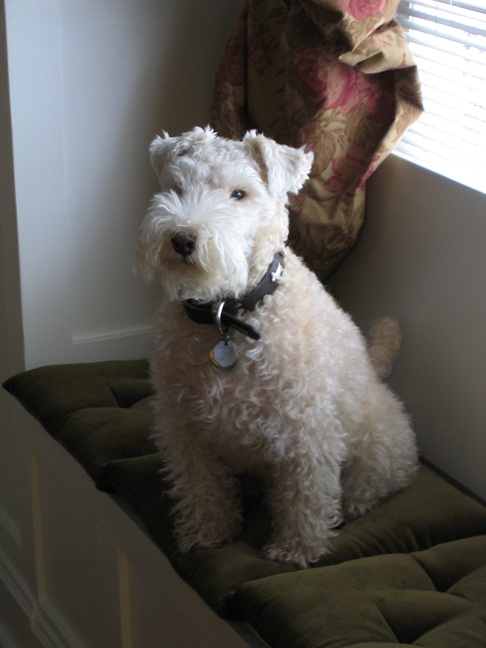
We gave him many names, dozens, because he had so much personality. Because he was so wooly and beastly looking, most people couldn't place his breed and thought he was a fortuitous mix of one or more shaggy dogs. He was, in fact, bred from champion Lakeland Terriers and his official AKC name was Snowtaire's Fritz Liebling. The breeder sold him because he was hopelessly short and stocky--which made him look all the more like a little bear. N's nickname for him was Bud. When he was a puppy I called him Spanky; most of his life Wicked, Wicky Boy, or Wackabu. This is a partial list of his many nicknames:

Liebling
Fritzikins, Fritzi-kun
Bud
Spanky, Spancticus, Horatio Spank
Wicked Dog, which became Wicky Boy, which morphed into Wackabu
Jaws of Death
Gacky
Snorky
Lurky Boy
Puffy (later Farticus Maximus)
Clever Lumpkin
Breath Weapon
Gentle Fang
Beastly Boy
Snifticus
Peanut
Peabody
Sir Drippabeard
Beardo

As Fritz grew into the old age of dogs, he never lost his passion for food, and walks, and drives in the car--anything that involved doing things with his people. He remained fairly healthy albeit rather lame in the last few years; some days he could climb stairs, others, I carried him. Oh, that reminds me of another name, Loado, sometimes Lodo Baggins, because he became heavier and more of a load in the latter days. But he was highly alert especially where food was concerned. He didn't want to miss out.

Nadine left for Pittsburgh in Dec 2010, and I think that her absence puzzled him. I could tell that he was concerned. He would lie near the bed on her side. He knew she was elsewhere, and accepted to wait for her return. But the days turned to weeks, then five months. When she returned to tie up loose ends, he was certainly happy to see her. I suspect that he had been sick for longer than I knew. Directly after she visited, he showed serious symptoms. I took him to the vet; they performed blood tests and an ultrasound. He had cancer throughout his liver. It was as if he waited to confirm that she were all right before he passed on. Surgery was an option, but the cancer was diffuse--highly unlikely it could be completely excised. The surgery itself might kill him or if not, at his age, a recovery would be very difficult. I didn't want him to suffer.

For the last week, I arranged my life around doing the things he liked. The day before he passed, we went to Golden Gardens, a splendid beach park and marina past the Ballard neighborhood of Seattle. It had been his very favorite walk when we used to live in the city. As always, it was blustery. The wind almost tipped him over, but when he got weak, I simply carried him. We sat on a bench and looked out at the wide grey horizon and listened to the endless waves for a very long time.

We never want those moments to end, I suppose. But each moment turns to the next, and the next, then tomorrow is today, and we're left, not with each other, but with memories.

It was a comfort that I took Fritz to Golden Gardens the day before, because that had been the last day he could walk. Now he was so weak he couldn't even stand. I put my feelings into a box that day, for I had a job to do. I took him to the vet. They had a cushion laid out on the table to make him comfortable. More than anything else, I was touched by this small gesture.

I called Nadine and Heidi on my mobile phone as we waited; I held the phone up to his ear as Nadine talked to Fritz, and she told him his favorite story, the story of Puffy. It was the story of how we went to get him when he was a puppy, and on the way back, we stopped at McD's and gave him a few french fries, which made him fart so much that we almost named him Puffy.

Then we all sang "Wooo-eee Fritzi" and Nadine and Heidi said goodbye.

I laid him on the cushion and he was very relaxed, very content just to lie there. Dogs know when their time has come. I was there by his side, put my hand on his head, and recited the 23rd psalm under my breath. When I came to "My cup runneth over" the vet said, "He's gone." There was no sign that anything had changed. He simply passed out of existence.


Fritz Liebling Trenton 1996 - 2011

I apologize for ending the story this way, but it was bound to happen. It had to be said, though, so we could understand that he left this lesson for us: On that last day, as I drove to the vet, I had the car window down because it was early May, the first nice warm Spring day after an interminable season of drizzle and chill. Fritz had been unable to stand for even a few seconds. Astoundingly, he got up, walked over my lap, and stuck his nose out the window to sniff the air as he had always liked to do. I held him up with my left arm so he could fully take the air as I drove. He was still fully engaged in life, wicked and living to the fullest, right up to the very end. We can learn from him... that maybe we can go out with style yet.

Tell me about the squirrel that jumps into my mouth again

And so my man and dog story ends, though it isn't told only for our benefit, but also for Fritz, the dog who loved a story well told.

2012-03-31

Winter Hours

Deer voyeur, Feb 2012

Before turning in, I wanted to share a few thoughts.

It's been a tough week. More like a tough month. Or a tough season. Not to whine, but here's the weird thing about The Valley... People think Winter is the hardest season. It's not. Winter is wonderful here. Spring, however, sucks. Especially March. We have a phenomemon here called "Winter Hours" which means "Everything's Closed." And it lasts until Memorial Day.

The anniversary of what happened this time last year has been weighing on me. It was preceded by a Winter with 100 consecutive days of rain, lasting well into March. Then it went down as follows: April 20, lost job; April 21, Happy Birthday!; April 25, found out Fritz had cancer; May 4, he was gone; May 5, moved to a new apartment. I call it the Black Fortnight.

However, things went better after that. Much better. Got a sane job that went well. The next apartment was great. I eventually had to move out here because I couldn't afford both rent and mortgage, but that went fairly well most of the time--with many hills and hollows.

It gives me comfort and hope to know that things can turn around so dramatically--but also I need to remember that it hasn't all gone steadily uphill--and it will continue to go up and down.

I must admit I've felt very isolated. Be that as it may, I'm going into Seattle this weekend to spend time with friends for my birthday, then the second week of May I'll be starting a new job and will be in town much more often.

Sometimes I wonder if I drive myself to extreme peculiarity by trying to make sense of it all. Some things make no sense. I don't believe God causes adversity to torment us, but he wants us to trust Him in the face of adversity. He created a physical world where--raining hellfire, shit, piss, and corruption--things can go wrong. Things fall apart, they fall down, they burn up, we can get hurt--and so can our feelings, even when something bad hasn't actually happened. But wonderful things can happen too. These possibilities were built into the world from the very beginning.

What keeps me going is a desire to move on. There are people to meet and places to see. I hope, when I get settled, to adopt a dog. Fritz would have wanted that. Actually, he wouldn't have--he would have viciously chased the other dog away and eaten his food. But he'd want me to move on and enjoy life, because he sure could enjoy life. He went for the gusto.

Not sure why I said this, I just had to say it.

2011-07-07

To the Dreary End

こんな夢を見た。。。

From the annals of the Dream Library, ~8:00am, 2011-07-07

I dreamed that reports had come out that the world was about to end soon. Naturally it was widely covered on cable news; subsequent bulletins and rumors said the event would occur somewhere around 8:30pm. To my surprise, there was no looting or general mayhem; instead, people became unusually pleasant and arranged informal get-togethers to chat about things and maybe bid farewells, if they thought to do so, but not everyone did. No one seemed particularly upset or grief-stricken, though the mood was a little sad, like seeing friends off at the airport, knowing you won't see them for a long time.

I was at an office building that afternoon, presumably at work and said goodbye to some friends. My thought was to get back to my car by 8:30 but then I realized that I had no real home or family to get home to, so I simply stayed where I was. The lobby had a small bar with a TV mounted up above, and a few people sat there talking, an older couple and a young woman. The older gent mixed drinks, free, for presumably no one bothered to charge money any longer. I watched the coverage on Fox News, which was predictably designed to string the audience along when nothing is actually happening, like their signature coverage of missing little girls that they milk on and on for weeks. I had no idea the end of the world would be so boring.

The time came and went. Not daring to be so impolite as to suggest that the world perhps had not ended, I suggested instead that maybe the world had changed in some fundamental way, some physical law of nature had been altered, but we hadn't noticed yet--that the world as we knew it had in fact ended, or perhaps we had ceased to exist in the reality we knew, but we were continuing on in a new reality.

The older couple at the bar were very down to earth and such wooly ideas simply breezed past them. I might as well have been recounting the premise of some pseudoscientific fantasy novel to them. The gentleman at the bar showed me a stunningly beautiful revolver; presumably he had taken it along in case of trouble, which happily had never materialized. It was a stainless steel Ruger snubnose with a 2 inch barrel and engraved vine-and-leaf scrollwork on an unfluted cylinder; caliber .22 magnum, and it held nine rounds. It must have been a special run, as I'd never seen the like before.

He put the pistol in a drawer while he mixed more drinks, and I noticed the young woman at the bar stealthily reach over and put it in her purse. I followed her out, thinking to win her confidence and maybe get the revolver back. We crossed a bridge as we talked and she told me that she was a runaway from a bad situation; I figured she needed cash, so I offered to buy the revolver from her, and I was even tempted to keep it for myself. However, she refused, as she thought she'd need it for protection. Unlike my aesthetic lust for the gun, her interest in it was purely practical--any pistol would have served her purpose.

The dream transitioned abruptly, and I was back at my car. Fritz was there waiting for me to take him along for the ride. I was lucidly aware that he had passed a few months ago, but the reality of his presence was so vivid that I ignored this fact. I picked him up and held him; I could feel his wooly fur and the warmth of his body, and he moved exactly as he had done in life. I put him in the passenger seat as usual and we were off. Originally I had planned to drive home, but now I wasn't sure where home was, and we seemed to have another destination, undefined. The drive was erratic, traffic frequently slowing and speeding up, with sudden stops. We crossed a bridge going rather fast, and hit a dip and hump in the pavement; the car lurched upward and seemed to leave the road's surface for a moment, but we continued on together, safely.

2011-06-20

On the Long Walk Home

In 2004, I wrote a short piece as part of a novel. The larger story itself is not relevant except that the theme was a young man's regret that he did not reconcile and get to know his father before the father's death. This parable was intended to be delivered as part of the father's eulogy. Worthy though it sound, it is one of the most leaned upon of themes, but one that, if not given over to sentimentality, rarely fails to engage.

It is a very simple tale of how a man deals with his beloved dog's final days. What is remarkable is that I wrote it almost seven years ago, when my dog Fritz was half his age, in full health, before he had any serious health problems. His first serious symptoms came about a year later--it turned out to be arthritis, but at first we had no idea what it might be, or how serious it was. I'm not claiming to scry, skein, or augur into future events. However, I sincerely believe that writing that is genuinely felt or deeply understood through hard experience--that is, true writing, taps into something ineffable that has a quality of cutting through time. It transcends what our poor senses cannot.

It's apparent that I was coming to terms with Fritz's end a long time ago. Some might call this a very foolish exercise in sentimentality. At the time it might have been, and it didn't make my feelings any easier when the end finally came. But it's stunning to me how closely this parable describes my feelings--and my relationship with Fritz in his last days--seven years later.

I had intended to publish this upon his death, but it needed work, and to be blunt, I didn't have the courage to return to this text for over a month. I took my time; I wanted it to be right, a fitting tribute to my little friend.

Someday we might spread Fritz's ashes at Golden Gardens Beach on Puget Sound, his favorite walk of all time, or possibly in the Methow Valley, where he owned a grand domain full of wildlife that he loved to sniff and survey. We might set down a stone. If we do, the epitaph might read:


There will never be another
Fritz


On the Long Walk Home

Once, a man owned a dog that had been a wonderful companion for many years, and the dog likewise trusted the man without reservation. Like all dogs, he craved the reassurance of routine. In fact, the more repeated the activity, the more it seemed to intensify the dog's enjoyment: the familiar smells along a walk, the nightly bone, the happy replenishment of the food and water bowls. He especially looked forward to his afternoon walk when the man returned from work.

In the course of years, the dog grew old, and though he had enjoyed an active, healthy life, he suddenly began to grow weak and listless. Concerned, the man took his dog to the veterinarian. The doctor told him that the dog had a serious disease, and though an operation was possible, it was doubtful that the dog would survive. He prescribed a few palliatives and told the man that if the dog's condition deteriorated, he could bring him in so that his suffering not be prolonged.

Certain thoughts weighed on the man as he headed home. The news was bad, but not surprising. He thought that he should feel worse, but instead felt strangely distant, and could only focus on what to do next. He knew that in the past he had slacked in his duties with the dog. Sometimes he might feel lazy and shorten their walk, or simply let the dog out into the yard. He determined that the days remaining to his dog should be the fullest possible--with everything he had come to expect in his daily routine.

The dog seemed well enough for several weeks, but then became quite sick. Again they went to the vet, who advised him to expect periods of seemingly restored health, punctuated by severe relapses. He cautioned him not to be buoyed by false recoveries. The man said that he understood, and asked how long they had. The vet said that the decision was entirely up to the owner, and the dog would let him know when it's time. The man wondered how he would know.

He took the dog home and struggled with the problem of when. On one hand it seemed selfish to let his friend continue suffering; on the other, he felt the dog deserved to live out whatever time he had. All he knew for certain was that he himself needed a little more time. He still took the dog for walks, but was careful not to go too long, lest the dog become exhausted. After a few days, it became clear that the dog could no longer go the least of what could be called a walk. The next day he decided to take the dog for one last outing.

When the time came, he approached the dog with the leash and said, let's go for a walk. The dog looked up wanly, but his tail quivered with the old enthusiasm. The dog bowed his head slightly to accept the leash, as he always did, and the man took comfort in knowing that the dog knew the ritual and found not a little joy in it.

He drove to a neighborhood that the dog liked, that was also near the vet's office. He knew the dog would recognize where he was, but it couldn't be helped. He took the dog to certain favorite spots, a tree-lined street, a playground where they would sometimes sit and simply watch the people and their kids, a vacant lot where rats and squirrels left their fascinating scents.

The dog took his time, investigating, sniffing at his leisure. And the man watched attentively. He wished that, instead of often being impatient on the way, he had paid closer attention to his friend's spirit of exploration, how he trotted from place to place, how he carefully sniffed, as if ruminating over the clues left him. How his friend stopped and watched the world with a calm that he himself would never know.

He wondered why he had never before put aside his fretting, busy thoughts to pause and observe life so.

After investigating a certain doorstep, his friend suddenly lay down beside the stoop and looked at him, panting slowly and deliberately but not whimpering or showing any pain. The man was seized with panic. Was this the sign? He simply wasn't ready. Then he justified himself with the sudden conviction that in this condition the dog couldn't possibly walk to the vet's office.

The man sat on the stoop and petted the dog for a while--it didn't seem long--and suddenly the dog stood up and tugged at the leash. The man was encouraged, and decided that they should go home, since this was obviously not the day. Perhaps he had jumped the gun. Yes, he should wait and see, take care of this tomorrow, or another day, for after all, the dog could become better unexpectedly--the vet had said himself that there was no predicting how it might go.

He stood up and tried to lead the dog back to the car, but the dog strained against the leash, wanting to continue the walk to its end--but that direction also led toward the vet. He gently urged the dog in the opposite direction. The dog headed stubbornly the other way. He didn't want to force his friend, not in his condition, and he felt that he should not interfere with the dog's wishes, not on this walk of all walks, so he allowed the dog to move on.

The man became anxious as they drifted further away from the car, and closer to the vet. To his relief, the dog took a detour, a right turn, and they headed off in yet another direction. Now as they were getting farther from both the car and the office, the man worried that a longer walk back might be too much for his friend--and further, that they'd also be too far from the office should his friend worsen. Or too close--he wasn't sure.

They came to a corner park, no more than a small, shady garden with a bench. He sat on the bench and his companion lay near his feet. The dog looked up at him again, panting soundlessly, happy to rest there for the moment.

The man too felt content. For a moment he forgot why he they were there, and it was once more just another of their walks, the usual routine that they both loved. He gazed round absently and enjoyed this one moment together. He felt he almost understood the way his dog gazed at the world: contentedly, serenely, but also intently observing.

He had accepted where the dog wanted to go, and was now ready to continue. He stood up and asked, are you ready? The dog remained where he lay, quiet and motionless. At first the man almost laughed, for he thought that the dog had fallen asleep, then a cold numbness ran through his veins. He crouched down, put his hand on the dog's head. He'd miss their walks, he thought, but he also felt grateful for the burden that had been lifted from him.

He gently took up his friend in his arms, and carried him on the long walk home.

2011-03-16

Tsunami Inu


津波犬   Tsunami inu, tsunami dog (lit. "harbor wave dog")

"There is another dog right next to the one sitting down. He is not moving. I wonder.... I wonder if he is alright. The dog is protecting him. Yes. He is protecting the dog. That is why he did not want us to approach them. He was trying to keep us at bay. I can't watch this. This is very difficult to watch. Oh. Look. He is moving. He is alive."

After the video was shot, the dogs were both taken into care of the local animal shelter.

2011-03-07

Vietnamese Dog Tree

I dreamed that Vietnamese people tied tiny toy dogs, or puppies, to the branches of small ash trees. They considered them to be holiday decorations, much like Christmas tree trimmings. But the little dogs kept slipping off the branches and had to scramble back up on their unnatural perches, lest they hang. The Vietnamese thought this was cute, but I felt very badly for the dogs. It felt similar to the tenuous struggle of my present financial and career situation.