2013-03-22
The Beast in Me
N and I were evaluating an apartment that appeared to be a converted basement, storefront, or loft. The structure had concrete walls partitioned with antique wood paneling and mouldings from sundry old buildings. The trim was a distressed, blackish tone. Ostensibly we were going to live there. Thus it would seem to be a point in the past when we were still together, but it's difficult to draw logical or temporal conclusions as dreams are neither subject to deterministic physical laws such as causality or entropy.
We kneeled down to eat dinner at a low table, like a coffee table, Japanese style. We ate fish. N sat opposite me and H was at my right hand. A huge tiger came up and lay between H and I; he rested his enormous head on the table. I was so terrified that I couldn't think what to do; I didn't want to retreat and abandon them or make any sudden move to provoke the tiger. It was completely docile, however. N seemed to act as if he were our pet, and looked at me sternly as if to scold me for letting my food get cold (a bad habit of mine which has provoked more than one woman).
I cut pieces of my fish and carefully slid them across the table with my knife, in hopes that the tiger would attend to the fish and not attack us.
When I awoke I was very perplexed by this dream. What could the tiger have been? I first recalled Blake's The Tyger:
Tyger, Tyger, burning bright,
In the forests of the night:
What immortal hand or eye,
Could frame thy fearful symmetry?
The commonly accepted interpretation is that the "Tyger"--versus an actual tiger--is an allegory and reconciliation of the apparently contradictory beauty and ferocity of nature. As Dr Ed Friedlander states in this unusually insightful commentary, the tiger represents "the beauty and the horror of the natural world."
But this was my tiger, something dark that I feared deeply within me. Was it my rage, my fear of failure, my lusts, my envy--which of these plentiful failings could it be? For there is no shortage of rage, no lack of injustices done unto me.
Certainly one of the things that surprised me most about my Lenten abstinence of alcohol and negativity (and a commitment to realism) has been sudden occasional reveries involving vengeance. Not exactly violent, but thinking of how those who deprecated me at work, for example, would be thrown before a tribunal and their perfidy exposed, perhaps in this life or better yet in the next so their torments could be meted out by pitiless demons. Hopefully those found in the Chinese hell, where they are fond of crushing their hapless victims to a pulp beneath a grindstone, sawed roughly into pieces by day and sewed up clumsily at night. What I have not learned of mercy during Lent has been replaced by a certain clarity of thought. I wish them a good life that their desserts be all the more delicious in the next. It will soothe my time in purgatory knowing my television will have a channel perpetually broadcasting despair and hellish suffering. Much like the E! channel.
But back to my tiger. What I've learned during my long period of quiet solitude is that my demons haven't been purged; they are merely tamed, for the time being, like the tiger. I have in my time of distress fed fish to my tiger--the fish being mercy and charity, in the same way Jesus fed fish to his followers when they came to hear Him on the mount. It seemed such a meager, futile gesture in the dream. I expected the tiger to maul me in the next instant. And yet it worked. It utterly placated the beast in me.
When the stars threw down their spears
And water'd heaven with their tears:
Did he smile his work to see?
Did he who made the Lamb make thee?
2013-03-18
Evolving Patterns
Blogs should evolve over time. Blog is, after all, short for "web log." If a log of someone's views never changes, then the person has stopped thinking while continuing to write. Which is one of the great banes of the Internet Age. Therefore, I'm introducing new themes.
Dreams. Too much emphasis is put on the symbology of dreams. Dreams are in fact symbolic functions of the mind. But symbology is too much open to subjective interpretation. I believe the meaning to dreams, is to be found in their pattern. Content or logic doesn't matter to the unconscious; only pattern does.
Innocence. I'll admit, it's too late for me. The decades of cynicism have taken their toll. But even if innocence be unreachable, I'm still fascinated by the way children see things. I need to pay more attention to this. Children look at the world in a novel way. For one thing, it's useful for creative endeavors and design. For another, it brings a kind of freshness and joy to seeing things that we tend to lose.
Music. Because, music. I hear way too much good music and really should share it.
Dreams. Too much emphasis is put on the symbology of dreams. Dreams are in fact symbolic functions of the mind. But symbology is too much open to subjective interpretation. I believe the meaning to dreams, is to be found in their pattern. Content or logic doesn't matter to the unconscious; only pattern does.
Innocence. I'll admit, it's too late for me. The decades of cynicism have taken their toll. But even if innocence be unreachable, I'm still fascinated by the way children see things. I need to pay more attention to this. Children look at the world in a novel way. For one thing, it's useful for creative endeavors and design. For another, it brings a kind of freshness and joy to seeing things that we tend to lose.
Music. Because, music. I hear way too much good music and really should share it.
2013-01-01
Lux Diei, Dies Lux
I've had this recurring dream.
I'm in a basement with N and H; we're looking for something, and she suddenly takes H and goes upstairs to the kitchen; she shuts and locks the basement door. I have a flashlight with me, but the batteries are weak and it dims quickly. I walk carefully up the stairs and pound on the door with the flashlight--at least it's good for that. It becomes harder and harder to breathe. Finally the door opens and I wake up struggling, gasping for air.
This is possibly the most obvious dream I've ever had. N did in fact take H away and leave me with a partially finished house.
I'm not writing this to wallow, but to recollect. I keep notes on events and feelings, I look for patterns, to make sense... which might well be a colossal waste of time. Yet I recorded a definite trajectory to my life, with the nadir being late April 2011. I remember that Easter, right before my birthday, as a dark struggle. Easter is billed as a season of hope and rebirth--but the seminal event itself was a time of great suffering.
That two week period of despair ended with Fritz's death. After his passing, ironically enough, my life gradually improved. Not steadily, but like a sawtooth, a bleeding, jagged edge upward.
Now that I feel solid again, I have to ask myself, when did the episodes of anxiety and depression stop? Because they did stop at some point--exactly when I don't know. I can say clearly I was healthier and happier one year later.
But it seemed to me there must have been an inflection point, when hope was greater than pain. After much thought and recollection, I narrowed it down to the Winter Solstice, 2011. I remembered a certain day when the sun shines through the window, all the way down the basement stairs, a few days before the solstice.
I was coming up the stairs that day, and suddenly, my head was filled with light; I was utterly blinded. I had walked right into the intense beam of sunlight as I came up the stairs. The ordinary light of day (lux diei) became the Day of Light (dies lux).
It's hard for our animal minds to see True Will at work in our lives. Animals have evolved to notice quick motion, so it's hard for our animal minds to pay attention to subtle, gradual change. We're often distracted, and we tend to confuse quickness with change. True Change is not quick, but sudden. Quick is a deer nimbly sprinting along a rocky river bank. Sudden is a hairline fracture appearing in a glacier before it shears off the mountain. Microscopic and silent, it is no less a catastrophe than the break, and the avalanche is merely a consequence.
I'm in a basement with N and H; we're looking for something, and she suddenly takes H and goes upstairs to the kitchen; she shuts and locks the basement door. I have a flashlight with me, but the batteries are weak and it dims quickly. I walk carefully up the stairs and pound on the door with the flashlight--at least it's good for that. It becomes harder and harder to breathe. Finally the door opens and I wake up struggling, gasping for air.
This is possibly the most obvious dream I've ever had. N did in fact take H away and leave me with a partially finished house.
I'm not writing this to wallow, but to recollect. I keep notes on events and feelings, I look for patterns, to make sense... which might well be a colossal waste of time. Yet I recorded a definite trajectory to my life, with the nadir being late April 2011. I remember that Easter, right before my birthday, as a dark struggle. Easter is billed as a season of hope and rebirth--but the seminal event itself was a time of great suffering.
That two week period of despair ended with Fritz's death. After his passing, ironically enough, my life gradually improved. Not steadily, but like a sawtooth, a bleeding, jagged edge upward.
Now that I feel solid again, I have to ask myself, when did the episodes of anxiety and depression stop? Because they did stop at some point--exactly when I don't know. I can say clearly I was healthier and happier one year later.
But it seemed to me there must have been an inflection point, when hope was greater than pain. After much thought and recollection, I narrowed it down to the Winter Solstice, 2011. I remembered a certain day when the sun shines through the window, all the way down the basement stairs, a few days before the solstice.
I was coming up the stairs that day, and suddenly, my head was filled with light; I was utterly blinded. I had walked right into the intense beam of sunlight as I came up the stairs. The ordinary light of day (lux diei) became the Day of Light (dies lux).
It's hard for our animal minds to see True Will at work in our lives. Animals have evolved to notice quick motion, so it's hard for our animal minds to pay attention to subtle, gradual change. We're often distracted, and we tend to confuse quickness with change. True Change is not quick, but sudden. Quick is a deer nimbly sprinting along a rocky river bank. Sudden is a hairline fracture appearing in a glacier before it shears off the mountain. Microscopic and silent, it is no less a catastrophe than the break, and the avalanche is merely a consequence.
2012-07-11
Gravity
My daughter the happy artist (欢艺) sent me this drawing for Father's Day. Blue giraffes I can accept--that is mere artistic license. What struck me was that when children represent the world, gravity doesn't matter. Or maybe giraffes have suction cups on their feet like squid. It doesn't matter whether it's real--what matters is whether you can imagine it. It's sad that we forget this as we grow into adultness, as if gravity flattens our imaginations over time.
I cleared a lot of stuff recently, including a pile of drawings that H drew a few years ago. She would have been about four. They were coloring books and sheets of paper that she had drawn on--doodles and primitive drawings; I kept the more humorous ones, but I felt something about the coloring books--they had to go of course--they contained nothing but scribbles, but leafing through them I got a vague sense of the innocent joy of filling shapes with color. This is probably universal to everyone when they are young, and eventually we forget about innocent joy. I suppose we convince ourselves over time that other things are more important--and they are--but as we become more and more busy fighting the gravity of life, joy is crowded out. The good news is, there's no reason we can't have it back at any time. We simply need to reach up and grab it--like a beach ball floating on the surface--though the water is murky and we rarely see it.
As it turned out, however, my speculations were incorrect. I put the drawing on the refrigerator next to Band-Aid Man (who most unfortunately fell asleep on a nest of Fire Ants, and had to but over a hundred band-aids all over his body). I called H and talked about the giraffes. She said that they were not actually walking on the ceiling, they were just drawn upside down. I've succumbed to the gravity of my situation and am utterly unable to understand the subtext of the drawing.
Labels:
Wisdom of the Ages,
Writing
2012-05-04
The Dog Who Loved a Story
![]() |
| Ever alert |
When I was in my twenties, I read Thomas Mann's long story (really a novella) called "A Man and His Dog." It's an enjoyable story, but it could hardly be published nowadays. It's an extended yet dense pastoral narrative of the long walks taken by a man and his dog. No doubt the Iowa School types would find it intolerably long-winded and pointless. I myself had trouble comprehending its message. The point was, like man's relationship to dogs, it is what it is.
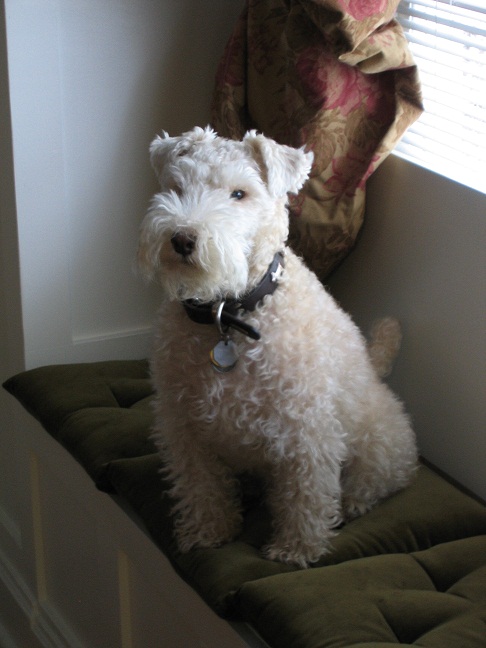
Perhaps this will be my Man and Dog story. I've written about my remarkable dog Fritz before, in End of an Era and On the Long Walk Home. But the first was a raw elegy mustered in a difficult time, and the second was a fictive watercolor of my emotions. It has taken me a year to distill these memories into a proper memoir, but more importantly, to attain enough distance to write it. I wanted to treat his memory with dignity, yet also with humor, for dogs have a sense of humor. He was a terrier with bushy eyebrows. It is not well-known, but terriers communicate with their eyebrows. When he was holding a ball, he would alternately raise one eyebrow, then the other, the alternate back and forth to tease you into grabbing for it, then at the very last second he would swipe it away: "Aha! Fooled you! Aha! Fooled you again!" And dogs are one of those creatures for whom a jest becomes more humorous the more it is repeated.
![]() |
| Giving you the brow |
Fritz understood a large vocabulary of words, all of which meant something was in it for him. For example, I had to be sparing in my use of the word "pizza" because if I ever mentioned it, Fritz would walk over and "nose" me--meaning stick his nose in my calf to indicate subtly that he wanted something--usually an excursion. If we didn't respond to nosing, we got an indignant stare, the sort that only a terrier can radiate. And then a series of low woofs and chirring which was his impression of human speech.
You must understand, to Fritz, the pizza shop was just another house that, when we visited, they give you food. They were okay with Fritz coming in and usually gave him a little pepperoni--which, of course, he came to expect.
Because of Fritz's response to human language, I came to believe that dogs also have their own functional language, somewhat guttural and direct, but by no means lacking in grammar. It's largely nonverbal, but if we were to vocalize it, it would come out somewhat with this sense:
Give to me
Pee on, now belong to me
Meet the Jaws of Death barking squirrel
Go now, get pizza
Let's celebrate--I chew, you watch
![]() |
| I chew, you watch |
![]() |
| Ah, a tasty meat-a-ball |
![]() |
| Poor old bull... where'd his ball go? |
Fritz did more to improve my mental health than years of therapy and meditation. He accompanied us on most of our walks, loved to stick his nose out the window on drives, and would wag his tail and dance when I came home from work. When I came home and he'd do that dance, how could I be angry or resentful? Not only did he know how to enjoy life, he taught me how to appreciate it.
Not all dogs are water dogs, but Fritz was. Lakelands were bred in the Lake District of England, on the borderlands of Scotland. If they see a hole, they will tunnel right in, searching for a rodent. Back in the day their tails were used to pull the dog back out of the hole if they got stuck. They're hardy dogs. A famous story is told of the Lakeland that got wedged under a deep rock formation and could not be dug out, so they blasted the rock with dynamite. The terrier emerged, tail wagging. If Lakelands see water, they splash right in. They love to frolic in snow.
| Hoza-yobi |
Being a terrier, his leaping powers were amazing, and the hose gave him a good workout. But in 2005, he started to limp. His back legs became very weak, and eventually he could hardly stand. We were very worried about him, and the first few diagnoses didn't land on the cause. We saw two or three vets before it was diagnosed as immunoarthritis. They prescribed Azathioprine, a medication that humans also use to treat arthritis, and he stayed on it the rest of his life. It enabled him to walk normally, maybe trot, but his running and jumping days were over.
That didn't keep him from relishing life, however. His main passion was food, and his very favorite was roasty beast (roast beef).
We gave him many names, dozens, because he had so much personality. Because he was so wooly and beastly looking, most people couldn't place his breed and thought he was a fortuitous mix of one or more shaggy dogs. He was, in fact, bred from champion Lakeland Terriers and his official AKC name was Snowtaire's Fritz Liebling. The breeder sold him because he was hopelessly short and stocky--which made him look all the more like a little bear. N's nickname for him was Bud. When he was a puppy I called him Spanky; most of his life Wicked, Wicky Boy, or Wackabu. This is a partial list of his many nicknames:
Liebling
Fritzikins, Fritzi-kun
Bud
Spanky, Spancticus, Horatio Spank
Wicked Dog, which became Wicky Boy, which morphed into Wackabu
Jaws of Death
Gacky
Snorky
Lurky Boy
Puffy (later Farticus Maximus)
Clever Lumpkin
Breath Weapon
Gentle Fang
Beastly Boy
Snifticus
Peanut
Peabody
Sir Drippabeard
Beardo
As Fritz grew into the old age of dogs, he never lost his passion for food, and walks, and drives in the car--anything that involved doing things with his people. He remained fairly healthy albeit rather lame in the last few years; some days he could climb stairs, others, I carried him. Oh, that reminds me of another name, Loado, sometimes Lodo Baggins, because he became heavier and more of a load in the latter days. But he was highly alert especially where food was concerned. He didn't want to miss out.
Nadine left for Pittsburgh in Dec 2010, and I think that her absence puzzled him. I could tell that he was concerned. He would lie near the bed on her side. He knew she was elsewhere, and accepted to wait for her return. But the days turned to weeks, then five months. When she returned to tie up loose ends, he was certainly happy to see her. I suspect that he had been sick for longer than I knew. Directly after she visited, he showed serious symptoms. I took him to the vet; they performed blood tests and an ultrasound. He had cancer throughout his liver. It was as if he waited to confirm that she were all right before he passed on. Surgery was an option, but the cancer was diffuse--highly unlikely it could be completely excised. The surgery itself might kill him or if not, at his age, a recovery would be very difficult. I didn't want him to suffer.
For the last week, I arranged my life around doing the things he liked. The day before he passed, we went to Golden Gardens, a splendid beach park and marina past the Ballard neighborhood of Seattle. It had been his very favorite walk when we used to live in the city. As always, it was blustery. The wind almost tipped him over, but when he got weak, I simply carried him. We sat on a bench and looked out at the wide grey horizon and listened to the endless waves for a very long time.
We never want those moments to end, I suppose. But each moment turns to the next, and the next, then tomorrow is today, and we're left, not with each other, but with memories.
It was a comfort that I took Fritz to Golden Gardens the day before, because that had been the last day he could walk. Now he was so weak he couldn't even stand. I put my feelings into a box that day, for I had a job to do. I took him to the vet. They had a cushion laid out on the table to make him comfortable. More than anything else, I was touched by this small gesture.
I called Nadine and Heidi on my mobile phone as we waited; I held the phone up to his ear as Nadine talked to Fritz, and she told him his favorite story, the story of Puffy. It was the story of how we went to get him when he was a puppy, and on the way back, we stopped at McD's and gave him a few french fries, which made him fart so much that we almost named him Puffy.
Then we all sang "Wooo-eee Fritzi" and Nadine and Heidi said goodbye.
I laid him on the cushion and he was very relaxed, very content just to lie there. Dogs know when their time has come. I was there by his side, put my hand on his head, and recited the 23rd psalm under my breath. When I came to "My cup runneth over" the vet said, "He's gone." There was no sign that anything had changed. He simply passed out of existence.
![]() |
| Fritz Liebling Trenton 1996 - 2011 |
I apologize for ending the story this way, but it was bound to happen. It had to be said, though, so we could understand that he left this lesson for us: On that last day, as I drove to the vet, I had the car window down because it was early May, the first nice warm Spring day after an interminable season of drizzle and chill. Fritz had been unable to stand for even a few seconds. Astoundingly, he got up, walked over my lap, and stuck his nose out the window to sniff the air as he had always liked to do. I held him up with my left arm so he could fully take the air as I drove. He was still fully engaged in life, wicked and living to the fullest, right up to the very end. We can learn from him... that maybe we can go out with style yet.
![]() |
| Tell me about the squirrel that jumps into my mouth again |
And so my man and dog story ends, though it isn't told only for our benefit, but also for Fritz, the dog who loved a story well told.
2012-04-21
Signals
Who among us, save the most encrusted materialist, has not longed for a sign--from above, from beyond, really from anywhere but here.
I have a strong conviction that "signs" are all around us, and seeing them is simply a matter of keeping an open mind.
Strangely enough, this week I found three receipts from April 21, my birthday, on three consecutive years: 2010, 2011, and 2012.
The first receipt indicated that my birthday in 2010, found us taking a leisurely drive to Chelan, WA, in the Columbia River wine country, and having a wonderful dinner at Sorrento's, a splendid Italian restaurant. It's hard to believe how we took such things for granted.
![]() |
| Lake Chelan |
The second receipt was from a garage in Issaquah--on my birthday in 2011, my car wouldn't start and I took it to this shop to have it repaired. They charged me the extravagant sum of $260 to poke around and replace the battery--which didn't address the real problem in the least. It was in fact a starter problem. But you're paying $75 per hour for expertise, don't you know. I also remember walking four miles to the shop to pick up my car, and having plenty of time to consider my career options, as I had lost my job the day before. That's what I can recall of my birthday, 2011.
The third receipt was from Ivar's, a chain of fish and chips restaurants in Seattle. I drove into town the weekend of my birthday to take care of several tasks, including a trip to IKEA. Every trip to IKEA is a rather surreal adventure. This time, I had a pleasant and extended phone conversation with N & H while walking through the Blue Valley, a quiet, shady courtyard between the two parking garages. It was one of those banal interludes that doesn't seem special at the time, and yet that you'll likely never forget.
Then I drove to Ivar's for fish and chips. I was so busy that I couldn't think of a better place to go--but that's a compliment because I know I always enjoy their food. I also had a nagging headache, and fish and chips is a sure cure.
![]() |
| IKEA's "Blue Valley" |
What do I glean from this? Prior to 2011, I was having economic challenges, but my family and economic life was still largely intact. In 2011, the structure of my life had largely fallen apart, and my birthday became the nadir of that drawn-out catastrophe. From that time through 2012, I gradually put my life back together, and had learned to enjoy life's simple pleasures.
![]() |
| Signs are a presumption of the mind |
And I'm more careful now not to draw solid conclusions about where my life is headed, based on a few signs. We often misunderstand how events unfold. We fail to understand the difference between "quick" and "sudden." God's action is sudden; everything lines up as necessary, a crisis point is reached, then change happens somewhat catastrophically. But the alignment might take weeks or months or decades, or happen at uneven rates. We expect the relationship of signs and events to be presented in a causal manner, when in actuality they're synchronistic. "Signs" are a subjective presumption of the mind. Instead, we need to open our minds to the subtly and suddenly unfolding.
The mistake we make is that signs are not explanations, but encrypted bread crumbs left along the way. Perhaps we look for signs when we are actually receiving signals.
2012-04-20
Things Fall Apart
I commiserated with myself for quite a while about whether I should post this. To be blunt, it's very personal, and not at all within the scope of what I'd intended for this venue. But I am worth little if I don't understand myself, and this essay describes a time of critical change in my life. It might also come to pass that I never have a chance to explain these lessons to others, especially my daughter, Heidi, so I've determined to record this here and now.
Last year (2011), Easter fell on April 24. It was a very tough time, and I attended Good Friday, Saturday night Easter Vigil, and Easter Sunday services. I strove to keep a strong faith and sought solace and understanding. It helped me to gain understanding, but it didn't prevent episodes of intense grief and depression. Since the previous Fall, I had lost two grandmothers, Nadine left and took our daughter Heidi to Pittsburgh. I lost my job on my birthday (the day before Good Friday), and just after Easter I discovered that my dog Fritz was gravely ill with liver cancer.
In the long run, it was good that I moved on from that job, but it fell at a time when I was terribly vulnerable. I lost all confidence in my skills and felt that my career was over. Relationships no longer seemed to work out. It was a false perception, but I could only see the rejection and failure of recent history. I felt used up, just a crumpled-up piece of paper.
Because I was experiencing loss so acutely, I came face to face with its reality. I wasn't just facing it, I was drowning in it. I had always tried to maintain an awareness that losses would inevitably come--over time, I would lose grandparents, parents, friends and other loved ones, pets along the way, and then I would go.
Of course, I was aware that these things happen. But I expected it to unfold in a more drawn out way, not clustered, as this was. The question I asked was not why me, but why all this, all now?
On a particularly hard day, right before Easter Sunday, I realized that I'd have to let go of the things I treasured, and release attachment to the people I loved in my life. Eventually you are going to lose everything, one way or another. Even though I had acknowledged this from time to time, it was an academic acknowledgement--now it was dense and ponderous and imminent. It was less a conscious realization than a palpable sense.
During this time, I had no idea that Fritz was ill. Ironically these thoughts were a prelude to his passing.
I tried to find notes on this, but I guess I'm not surprised that I wrote hardly anything at the time. The fortnight between my birthday and Fritz's passing is a black hole. All I remember was arranging my life around making the most of my time with him and trying to do all the things that he enjoyed most.
The day after Fritz passed on, I moved to a new apartment and later that month, started a new job. My life took a sawtoothed yet gradually upward trend from there. It's taken a year to get proper distance and perspective to write about it. I can look back over the long rough road, yet I still resist optimism as purest folly.
This year (2012), during Lent, I kept an open mind, hoping for insight. I had my usual ups and downs, and I realized two things: One is that you have to uphold your faith when it's hard to do so, when things are dark--it's not just for sunny days dressed up for Sunday brunch. The other is that your emotions about events don't actually matter--the events occur anyway. It's not that God doesn't care, but He's hands off, quiet, always behind the scenes, the subtlest operator. It seems harsh, but it's the way the world works. And it's our responsibility to understand the world and its workings, so that we can live in it.
Then on Easter, I meditated on how far I had come since last year--I called it the Easter Crisis, as it seemed my life was falling apart around me. And it literally did. Over and over I obsessed on the infamous line from Yeats' "Second Coming:"
Now, when I'm confronted with a problem that seems overwhelming, I remind myself: it's not a money problem... it's not a career problem... it's not a house problem... or whatever the problem seems to be... it's a mind problem. Then I can deconstruct it and break it down into chunks that can be done one by one.
And this year I set commitments around goals like: Build a stable foundation. Be effective. Move on. Get help. Face your fear. It's working. I stand in a different relationship with the world and with people. I'm far less impressed or obsessed with material things. I wasn't terribly in love with money to begin with, but I certainly fell into the trap of thinking that buying "this one thing" will solve a problem. Yes, sometimes you need tools or materials to help you accomplish goals, but it's really all about skills. And I now see wealth more as a means of sustaining yourself and your family, and as a bulwark against hardship, legal attacks, and transgressions against your rights and property.
Most of all, I understand that I would never have changed had a catastrophic turn of circumstance not awakened me. I was so profoundly flawed in some ways that only having my life shattered and rebuilt brick by brick would restore me.
As I was, I would never have fulfilled the potentials that God intended for me. It sounds perverse, but the more I think about that, the more I see that God truly cares whether I realize my potentials.
Last year (2011), Easter fell on April 24. It was a very tough time, and I attended Good Friday, Saturday night Easter Vigil, and Easter Sunday services. I strove to keep a strong faith and sought solace and understanding. It helped me to gain understanding, but it didn't prevent episodes of intense grief and depression. Since the previous Fall, I had lost two grandmothers, Nadine left and took our daughter Heidi to Pittsburgh. I lost my job on my birthday (the day before Good Friday), and just after Easter I discovered that my dog Fritz was gravely ill with liver cancer.
In the long run, it was good that I moved on from that job, but it fell at a time when I was terribly vulnerable. I lost all confidence in my skills and felt that my career was over. Relationships no longer seemed to work out. It was a false perception, but I could only see the rejection and failure of recent history. I felt used up, just a crumpled-up piece of paper.
Because I was experiencing loss so acutely, I came face to face with its reality. I wasn't just facing it, I was drowning in it. I had always tried to maintain an awareness that losses would inevitably come--over time, I would lose grandparents, parents, friends and other loved ones, pets along the way, and then I would go.
Of course, I was aware that these things happen. But I expected it to unfold in a more drawn out way, not clustered, as this was. The question I asked was not why me, but why all this, all now?
On a particularly hard day, right before Easter Sunday, I realized that I'd have to let go of the things I treasured, and release attachment to the people I loved in my life. Eventually you are going to lose everything, one way or another. Even though I had acknowledged this from time to time, it was an academic acknowledgement--now it was dense and ponderous and imminent. It was less a conscious realization than a palpable sense.
During this time, I had no idea that Fritz was ill. Ironically these thoughts were a prelude to his passing.
I tried to find notes on this, but I guess I'm not surprised that I wrote hardly anything at the time. The fortnight between my birthday and Fritz's passing is a black hole. All I remember was arranging my life around making the most of my time with him and trying to do all the things that he enjoyed most.
The day after Fritz passed on, I moved to a new apartment and later that month, started a new job. My life took a sawtoothed yet gradually upward trend from there. It's taken a year to get proper distance and perspective to write about it. I can look back over the long rough road, yet I still resist optimism as purest folly.
This year (2012), during Lent, I kept an open mind, hoping for insight. I had my usual ups and downs, and I realized two things: One is that you have to uphold your faith when it's hard to do so, when things are dark--it's not just for sunny days dressed up for Sunday brunch. The other is that your emotions about events don't actually matter--the events occur anyway. It's not that God doesn't care, but He's hands off, quiet, always behind the scenes, the subtlest operator. It seems harsh, but it's the way the world works. And it's our responsibility to understand the world and its workings, so that we can live in it.
Then on Easter, I meditated on how far I had come since last year--I called it the Easter Crisis, as it seemed my life was falling apart around me. And it literally did. Over and over I obsessed on the infamous line from Yeats' "Second Coming:"
Things fall apart; the centre cannot hold...My former life is no more. I'm not the same person I was a year ago. I see things differently; I act and react with the world differently; I approach problems and challenges differently.
Now, when I'm confronted with a problem that seems overwhelming, I remind myself: it's not a money problem... it's not a career problem... it's not a house problem... or whatever the problem seems to be... it's a mind problem. Then I can deconstruct it and break it down into chunks that can be done one by one.
And this year I set commitments around goals like: Build a stable foundation. Be effective. Move on. Get help. Face your fear. It's working. I stand in a different relationship with the world and with people. I'm far less impressed or obsessed with material things. I wasn't terribly in love with money to begin with, but I certainly fell into the trap of thinking that buying "this one thing" will solve a problem. Yes, sometimes you need tools or materials to help you accomplish goals, but it's really all about skills. And I now see wealth more as a means of sustaining yourself and your family, and as a bulwark against hardship, legal attacks, and transgressions against your rights and property.
Most of all, I understand that I would never have changed had a catastrophic turn of circumstance not awakened me. I was so profoundly flawed in some ways that only having my life shattered and rebuilt brick by brick would restore me.
As I was, I would never have fulfilled the potentials that God intended for me. It sounds perverse, but the more I think about that, the more I see that God truly cares whether I realize my potentials.
2012-03-31
Winter Hours
![]() |
| Deer voyeur, Feb 2012 |
Before turning in, I wanted to share a few thoughts.
It's been a tough week. More like a tough month. Or a tough season. Not to whine, but here's the weird thing about The Valley... People think Winter is the hardest season. It's not. Winter is wonderful here. Spring, however, sucks. Especially March. We have a phenomemon here called "Winter Hours" which means "Everything's Closed." And it lasts until Memorial Day.
The anniversary of what happened this time last year has been weighing on me. It was preceded by a Winter with 100 consecutive days of rain, lasting well into March. Then it went down as follows: April 20, lost job; April 21, Happy Birthday!; April 25, found out Fritz had cancer; May 4, he was gone; May 5, moved to a new apartment. I call it the Black Fortnight.
However, things went better after that. Much better. Got a sane job that went well. The next apartment was great. I eventually had to move out here because I couldn't afford both rent and mortgage, but that went fairly well most of the time--with many hills and hollows.
It gives me comfort and hope to know that things can turn around so dramatically--but also I need to remember that it hasn't all gone steadily uphill--and it will continue to go up and down.
I must admit I've felt very isolated. Be that as it may, I'm going into Seattle this weekend to spend time with friends for my birthday, then the second week of May I'll be starting a new job and will be in town much more often.
Sometimes I wonder if I drive myself to extreme peculiarity by trying to make sense of it all. Some things make no sense. I don't believe God causes adversity to torment us, but he wants us to trust Him in the face of adversity. He created a physical world where--raining hellfire, shit, piss, and corruption--things can go wrong. Things fall apart, they fall down, they burn up, we can get hurt--and so can our feelings, even when something bad hasn't actually happened. But wonderful things can happen too. These possibilities were built into the world from the very beginning.
What keeps me going is a desire to move on. There are people to meet and places to see. I hope, when I get settled, to adopt a dog. Fritz would have wanted that. Actually, he wouldn't have--he would have viciously chased the other dog away and eaten his food. But he'd want me to move on and enjoy life, because he sure could enjoy life. He went for the gusto.
Not sure why I said this, I just had to say it.
2011-11-04
A Day That Shall Live in Infamy
Two years ago today, November 4, I was laid off from Microsoft. I subsequently discovered that corporations have abused the foreign worker visa system in order to replace US workers with foreign workers.
The following letter is being sent to Senators Chuck Grassley (R-IA) and Dick Durbin (D-IL), and will subsequently be sent to several lawmakers across the country who are involved with commerce and immigration issues.
It is not my intention to make a political statement here. I removed political content from this blog over a year ago, as I wanted this to be a venue to focus inwardly, to contemplate culture and life. However, this issue has become very important to me and I've spent many evenings researching the issue. People who know me know that I'm not a xenophobe. I will therefore not justify myself with the usual bowing and scraping about not being a bigot and so forth. However, as I point out in the letter, I've been a free trade, free immigration advocate. And it's because I've been welcoming to other cultures that I feel all the more betrayed by these corrupt and cynical abuses.
Enough is enough.
The Honorable Richard Durbin
United State Senate
Washington, DC 20510
I'm writing today first to thank you for the work you've already done on the issue of visa abuse, particularly on the Durbin-Grassley H-1B and L-1 Visa Reform Act of 2009 (S.887), and to encourage you to continue giving it as much attention as possible in this time of urgent budgetary issues. I would also like to bring to your attention some aspects of the issue that I’ve observed.
It’s probably no surprise to you that the foreign worker visa system comprising H-1B, L-1, B-1, and other visas, has a high level of abuse. For over two decades I’ve worked with many professionals from other countries, whom I’ve found to be honest and intelligent people, and some of whom are personal friends. I supported the H-1B program because I believed it to be an implementation of controlled immigration that brought exceptional workers to the US.
I’ve found, however, that it has become a Trojan Horse for foreign corporations to take over entire business functions (such as software testing) and replace them wholesale with their own employees. The practice of US companies to cut their bottom line by outsourcing certain functions to other countries, or to bring in foreign workers at cheaper wages is debatable, if controversial. But that paints only half the picture.
Foreign corporations, with the aid of their governments, are waging an aggressive campaign on our economy to take over market share by corrupting the legal framework of US immigration and employment law. This campaign is waged under the rubric of "insourcing."
In countries such as India and China, the distinction between large conglomerates and government functions is virtually indistinct. These large corporations have very close relationships with their governments, which lend them special support and favored treatment. The most obvious of such support is the the Indian and Chinese governments’ lobbying of our government to expand the professional visa program.
Indian corporations must be identified as the primary agents in the insourcing campaign. In recent years, 80% of H-1B visas granted have gone to India-based outsourcing firms. Employees of these firms enter the US workforce and study how their respective businesses operate. Many persuade their US business contacts to outsource the rest of their department's work to India, or even more attractively, have their consulting company pitch an offer to provide an entire team of foreign visa workers to replace the current team at a far lower overall cost of operations--lower wages, and virtually no benefits overhead. Doing so using H1-B visas skirts legality and certainly violates the intent of the program. Doing so using B-1 visas is clearly illegal, and some foreign consulting firms have been caught red-handed at it.
Once one company significantly cuts their bottom line by insourcing, other companies compete by following suit. In the present ongoing recession, we’ve seen a chain reaction of companies resorting to this practice.
Worse, this legal and ethical shortcut tempts US executives to eliminate entire teams of US citizens, through elaborately planned management methods, euphemistically called reductions in force, redundancies, forced rankings, etc. Further, it is well known in the industry that some Indian executives simply make a deliberate effort to hire their own countrymen into their organization.
I’ve always supported the right of companies to hire and fire according to their business needs; however, the wholesale replacement of US workers is unethical, and the practice of "body shopping" pushes right through the ethical envelope into illegality. Consulting firms known as "body shops" apply for as many visas as possible, often falsifying the credentials of the workers whom they sponsor. Once they obtain a visa, they shop out the worker to other recruiting firms, to fill job descriptions that do not necessarily match that stated on their visa. Indeed, in some respects, the workers are chattel. If they complain, are resistant to an assignment, or step out of line in any respect, they can have their visa yanked and be sent back to their home country with no recourse.
My personal experience at Microsoft has confirmed everything that I've read about the system. I was a 13-year veteran with a solid record who was laid off along with 5800 other employees in 2009. As I mentioned, I appreciated working with talented people from around the world, and I supported the visa system. When I returned as a contractor in 2010, I saw that the demographic of the company had changed noticeably. Entire test teams were Indian nationals working for India-based consulting firms. It is not difficult to identify employees and the company through which they contract, as this information is readily available in the Outlook global address book.
It’s well known at Microsoft that certain groups have inordinately high rates of hire of Indian nationals. By my count, in one product group, over 35% of the team members were East Indian--considerably more than just one year before. East Asians comprised 12.5%, about the usual level at Microsoft. Like many other prominent high-tech companies, Microsoft has a much-touted Diversity program that’s supposed to encourage, well, diversity--and a strict anti-discrimination policy. Normally, were a manager to hire an entire team based on nationality or ethnicity, HR would have investigated and reprimanded that manager. But neither HR nor Diversity have raised any concerns about what appears to be a consistent pattern of preferential hiring.
In the past I’ve requested demographic data from Diversity to see how Microsoft compares to the population at large. Diversity replied that the company does not disclose its workforce demographics, nor its metrics or criteria for achieving diversity goals. I cannot help but wonder if “Diversity” teams in other high-tech companies are similarly used as window dressers to provide cover for questionable hiring practices.
Just as disturbing, however, is how the Indian-owned/managed recruiters have been cutting in front of local established recruiting firms--through their contacts within companies, the use of "Minority Owned Business" certifications, and "Preferred Vendor" status. These designations afford them protective cover and special consideration, since companies are under pressure to farm out business to minority-owned companies. It seems a cynical misuse of such certifications, meant to give a boost to traditionally underrepresented or disadvantaged groups of US citizens. Indian recruiters are aggressive, and some will exaggerate or misrepresent job descriptions to lure candidates away from local consulting firms.
Knowing this, it’s hard not to conclude that there is an ongoing coordinated campaign of foreign corporations and government to take advantage of our visa system to grab a huge share of our job market. This was never the intention of the professional/academic visa system, which was to bring in people so exceptional that a replacement couldn’t be found in the domestic labor pool. This violates at least the spirit of the law.
The Indian Chambers of Commerce have anticipated the backlash against outsourcing and incourcing and have outlined a strategy to lobby the Indian Government to push for relaxation of US visa requirements. Please urge Congress to resist these PR efforts.
I encourage you to reintroduce your H-1B and L-1 visa reform bill (S.887), which would effect much needed visa reform. I would make the following suggestions:
The following letter is being sent to Senators Chuck Grassley (R-IA) and Dick Durbin (D-IL), and will subsequently be sent to several lawmakers across the country who are involved with commerce and immigration issues.
It is not my intention to make a political statement here. I removed political content from this blog over a year ago, as I wanted this to be a venue to focus inwardly, to contemplate culture and life. However, this issue has become very important to me and I've spent many evenings researching the issue. People who know me know that I'm not a xenophobe. I will therefore not justify myself with the usual bowing and scraping about not being a bigot and so forth. However, as I point out in the letter, I've been a free trade, free immigration advocate. And it's because I've been welcoming to other cultures that I feel all the more betrayed by these corrupt and cynical abuses.
Enough is enough.
11-04-2011
The Honorable Charles GrassleyThe Honorable Richard Durbin
United State Senate
Washington, DC 20510
Donn Trenton
88 Wolf Creek Road
Winthrop WA 98862
Dear Senators Grassley and Durbin,88 Wolf Creek Road
Winthrop WA 98862
I'm writing today first to thank you for the work you've already done on the issue of visa abuse, particularly on the Durbin-Grassley H-1B and L-1 Visa Reform Act of 2009 (S.887), and to encourage you to continue giving it as much attention as possible in this time of urgent budgetary issues. I would also like to bring to your attention some aspects of the issue that I’ve observed.
It’s probably no surprise to you that the foreign worker visa system comprising H-1B, L-1, B-1, and other visas, has a high level of abuse. For over two decades I’ve worked with many professionals from other countries, whom I’ve found to be honest and intelligent people, and some of whom are personal friends. I supported the H-1B program because I believed it to be an implementation of controlled immigration that brought exceptional workers to the US.
I’ve found, however, that it has become a Trojan Horse for foreign corporations to take over entire business functions (such as software testing) and replace them wholesale with their own employees. The practice of US companies to cut their bottom line by outsourcing certain functions to other countries, or to bring in foreign workers at cheaper wages is debatable, if controversial. But that paints only half the picture.
Foreign corporations, with the aid of their governments, are waging an aggressive campaign on our economy to take over market share by corrupting the legal framework of US immigration and employment law. This campaign is waged under the rubric of "insourcing."
In countries such as India and China, the distinction between large conglomerates and government functions is virtually indistinct. These large corporations have very close relationships with their governments, which lend them special support and favored treatment. The most obvious of such support is the the Indian and Chinese governments’ lobbying of our government to expand the professional visa program.
Indian corporations must be identified as the primary agents in the insourcing campaign. In recent years, 80% of H-1B visas granted have gone to India-based outsourcing firms. Employees of these firms enter the US workforce and study how their respective businesses operate. Many persuade their US business contacts to outsource the rest of their department's work to India, or even more attractively, have their consulting company pitch an offer to provide an entire team of foreign visa workers to replace the current team at a far lower overall cost of operations--lower wages, and virtually no benefits overhead. Doing so using H1-B visas skirts legality and certainly violates the intent of the program. Doing so using B-1 visas is clearly illegal, and some foreign consulting firms have been caught red-handed at it.
Once one company significantly cuts their bottom line by insourcing, other companies compete by following suit. In the present ongoing recession, we’ve seen a chain reaction of companies resorting to this practice.
Worse, this legal and ethical shortcut tempts US executives to eliminate entire teams of US citizens, through elaborately planned management methods, euphemistically called reductions in force, redundancies, forced rankings, etc. Further, it is well known in the industry that some Indian executives simply make a deliberate effort to hire their own countrymen into their organization.
I’ve always supported the right of companies to hire and fire according to their business needs; however, the wholesale replacement of US workers is unethical, and the practice of "body shopping" pushes right through the ethical envelope into illegality. Consulting firms known as "body shops" apply for as many visas as possible, often falsifying the credentials of the workers whom they sponsor. Once they obtain a visa, they shop out the worker to other recruiting firms, to fill job descriptions that do not necessarily match that stated on their visa. Indeed, in some respects, the workers are chattel. If they complain, are resistant to an assignment, or step out of line in any respect, they can have their visa yanked and be sent back to their home country with no recourse.
My personal experience at Microsoft has confirmed everything that I've read about the system. I was a 13-year veteran with a solid record who was laid off along with 5800 other employees in 2009. As I mentioned, I appreciated working with talented people from around the world, and I supported the visa system. When I returned as a contractor in 2010, I saw that the demographic of the company had changed noticeably. Entire test teams were Indian nationals working for India-based consulting firms. It is not difficult to identify employees and the company through which they contract, as this information is readily available in the Outlook global address book.
It’s well known at Microsoft that certain groups have inordinately high rates of hire of Indian nationals. By my count, in one product group, over 35% of the team members were East Indian--considerably more than just one year before. East Asians comprised 12.5%, about the usual level at Microsoft. Like many other prominent high-tech companies, Microsoft has a much-touted Diversity program that’s supposed to encourage, well, diversity--and a strict anti-discrimination policy. Normally, were a manager to hire an entire team based on nationality or ethnicity, HR would have investigated and reprimanded that manager. But neither HR nor Diversity have raised any concerns about what appears to be a consistent pattern of preferential hiring.
In the past I’ve requested demographic data from Diversity to see how Microsoft compares to the population at large. Diversity replied that the company does not disclose its workforce demographics, nor its metrics or criteria for achieving diversity goals. I cannot help but wonder if “Diversity” teams in other high-tech companies are similarly used as window dressers to provide cover for questionable hiring practices.
Just as disturbing, however, is how the Indian-owned/managed recruiters have been cutting in front of local established recruiting firms--through their contacts within companies, the use of "Minority Owned Business" certifications, and "Preferred Vendor" status. These designations afford them protective cover and special consideration, since companies are under pressure to farm out business to minority-owned companies. It seems a cynical misuse of such certifications, meant to give a boost to traditionally underrepresented or disadvantaged groups of US citizens. Indian recruiters are aggressive, and some will exaggerate or misrepresent job descriptions to lure candidates away from local consulting firms.
Knowing this, it’s hard not to conclude that there is an ongoing coordinated campaign of foreign corporations and government to take advantage of our visa system to grab a huge share of our job market. This was never the intention of the professional/academic visa system, which was to bring in people so exceptional that a replacement couldn’t be found in the domestic labor pool. This violates at least the spirit of the law.
The Indian Chambers of Commerce have anticipated the backlash against outsourcing and incourcing and have outlined a strategy to lobby the Indian Government to push for relaxation of US visa requirements. Please urge Congress to resist these PR efforts.
I encourage you to reintroduce your H-1B and L-1 visa reform bill (S.887), which would effect much needed visa reform. I would make the following suggestions:
·
I strongly suggest that you strengthen the prohibition
against displacing US workers. Sec.113. Waiver Requirements would amend the Immigration
and Nationality Act to require an employer to establish that an H-1B worker "has
not displaced, and does not intend to displace, a United States worker employed
by the employer within the period beginning 180 days before and ending 180 days
after the date of the placement of the nonimmigrant with the employer." I suggest
adding a positive prohibition to the following effect:
Any corporation doing
business in the US that lays off more than 50 US-based employees in a fiscal
year may not sponsor, invite, or hire any foreign visa workers until one year
after the date of the last layoff.
The number can be indexed to the size of the company;
the point is to provide a strong disincentive to companies against hiring visa
workers rather than domestic workers shortly after layoffs.
·
Propose a temporary moratorium or limitation of the H-1B and
other visa programs, allowing current visa holders to stay the length of their
term, until Congress has investigated and considered how to reform the visa
system.
·
Revise the visa lottery system so that no one country can
obtain more than 50% of the visas granted for the year.
·
Remove the provision that DOL could initiate investigations
without a complaint and without the Labor Secretary’s personal authorization. This
is my only disagreement with your bill, as it might give the DOL too much latitude
and encourage overzealous investigations.
Once
again, I would like to thank you for all your efforts to protect the integrity
of our visa system and the rights of US citizens.
Sincerely,
Donn Trenton
Donn Trenton
2011-10-07
Quit While You're Ahead
There's a lesson to be be learned in the Methow Valley wolf scandal. A series of lessons, in truth.
If you're going to poach, don't poach an endangered species. If you're going to poach an endangered species, mount the head or pelt in your den and say you inherited it from your bibulous uncle--don't brag about it and certainly don't sell it. If you're going to sell it, don't ship it across state lines (involving the FBI) or to another country (involving the US Customs Service).
But if you really must sell the pelt of an endangered species that you poached and ship it via Fed Ex to another country, for God's sake put it in a Ziploc bag so blood doesn't leak all over, giving the good people at the Fed Ex drop-off cause to think you're shipping your husband's head to Canada.
Moral (choose one of the following):
a. Stupid is as stupid does.
b. When you're in a hole, stop digging.
c. Quit while you're ahead.
d. What was the question?
2011-09-16
Death of the Quiet Society
![]() |
| The Adventures of Simplicissimus |
Lawn Nazis
I had forgotten that Friday is landscaping day at my apartment complex. I had been working late, slept in somewhat, and woke to the gentle strains of leaf blowers directly outside my window. It was kind of these gentlemen to give me a wake up call exactly at 8:00am.
The modern corporation has solved the office smoking problem and office sexual harrassment problem by simply not having offices anymore. We all work from home. People think this is a dream job, but it isn't; much of my workday is spent finding a suitable workspace, and our lawns are the workplace of so many others. It is amazing that in an ailing economy we spend so much money keeping up the pretense of fastidiously manicured lawns. As William F Buckley once famously paraphrased La Fontaine, "Quelle est cette merde?" What indeed is this fetish about wide expanses of perfectly clipped grass? More significantly, why do we accept the attendant racket that comes with it? What is most disturbing is that no one, a la Candide, attends to their own garden anymore. Not so long ago, people raked their own damn leaves, and it was a long, meditative session of white noise--the rake scratching along the ground, puffing on a cigarette, and perhaps an Autumn breeze gusting by. Then flinging the cigarette away to set the neighborhood ablaze. Now it is done by others, hired to come and invade one's property with the shrill turbine whine of leaf blowers. The opportunity of meditation is lost, not only for you, but for all your neighbors. But to hell with them, the grounds are perfect.
With no hope of being allowed to concentrate, I dressed and went to the library to work.
The Lyceum of Grabassia
The public libraries in my upscale suburban community are well-appointed and designed in a modern, updated style of the classic Northwest mountain lodge. They have audio visual sections and meeting rooms, banks of computers, spacious sections for Children's literature, Young Adult fiction, and the newest mode, teen-only study rooms. All this unfortunately leaves only marginal space for a few carrels of books, and those are increasingly filled with thrillers, tales of gory lurid gore, bodice rippers, and the latest transcriptions of cultural bloviation.
People do not seem to read in the modern library. Why should they? There is much else to do. Answer your phone, text, tweet, chatter, surf, and scurry about in a daylong session of grabassia.
When did our libraries stop being places of of almost reverent silence and become ersatz Romper Rooms? Since when did libraries have to provide day care services? Likewise, why have large sections of libraries been cordoned off for the exclusive use of pimply, wetwired adolescents? The rest of the library is pretty much taken over by old farts such as myself and a few homeless people, who actually fit in rather better than the rest. They might smell, but they read silently and attentively, or better, doze off.
The Great Sniffer of Koryo
Chief among the annoyances, however, among the screeching brattle of unattended waifs and high whine of high-powered Mexican leaf blowers, is the Dreaded Asian Sniffer. Over the years in the diverse Northwest, I've learned much about Asian cultures--the most useful aspect of which is what Asian people do with their mucus.
To the Japanese, blowing one's nose is a gesture of such mortifying rudeness that were one to use a tissue, he would have to exile himself from refined company pretty much forever. The Japanese solution, therefore, when assaulted by the common cold, is cunningly and unobtrusively to wear a surgical mask wherever you go. And what happens behind the mask, stays behind the mask.
The Chinese, I hesitate to report, simply lay a finger aside the nose and hurl it out onto the sidewalk without further consideration. In fact in Jiangxi province it is considered an egregious insult if you do not luge on your neighbor's doorstep before entering.
The Koreans, being historically caught in the middle of these two cultures, cannot decide what the hell to do and simply sniff. In such manner, kotagji can be stored in the ko for hours on end. Oh yes, and if you believe there exists a more annoying sound in the universe, try enduring the occasional yet inevitable long uptake of a runny nose for an hour or so. No earphone or earbud piping in Metallica, can blot out the deadly sniffer.
Pornography and Invisibility
But what endears me most to the library is that, on the best days, I can almost vanish, mentally at least, from the noisome, attention-deficit world at large. To be fair, allow me to point this out: I am more attention-deficit than most. And that is why the library had in the past been for me a sort of guilty pleasure, a wandering about in a sort of Borgesian pleasure dome. Now that inner world has been replaced by the Internet. Is it trite to say it's not the same? Yes, trite.
When you're in a library, you are physically within a library. When you're in cyberspace, you're probably in your pyjamas, and I shall not conjecture further on your threadedness.
We now pretend to search by means of Googling; back in The Day ("The Day" or "ye olde days" being in my 6 year old daughter's words when queried about an ancient book, "The 80s?"), "googling" was checking out a voluptuous coed from betwixt the books of a nearby carrel. Now it is a lame exercise in which a computer tries to finish your sentence as you type, viz. when I tried to research (for purely academic purposes) the keyword string: "Asian hot" and got rather unsatisfying longtails such as:
asian hotel owners association
Essaying forth once more, I did better with:
asian hot dog eating contest winner
Which, for all practical purposes, was close enough. Bravo for Google! Yet the experience is just not the same. It is simply too... virtual for my taste. If I want exposure to porn, I only need go back to one of the larger city libraries, sit behind some good gentleman, and observe casually his online research. Why, only the other day, I sat in the Bellevue Main Library behind an upstanding African American fellow, and was surprised to see a kind of pornography I had never yet observed (and was heretofore grateful for the fact).
This fellow was in the process of "researching" photographs of extremely corpulent females. Perhaps he had mistakenly landed on a site such as celluliteplanet.com; I am not certain. He expanded a photo of the largest female bollocks imaginable; it not only eclipsed the screen, I thought it might perhaps bring the library servers down.
No such luck. However, the man sniffed not at all, nor made any sound, and it went down as one of my more productive days at the library. So I say, pipe in terabytes of porn, give library passes to the trenchcoat brigade, bring Robert Mapplethorpe himself into the library, let him sign books with... well, let him perform a book signing in his own inimitable way!
Maybe then I can get some damn work done.
2011-09-11
The Light of the Living
You number my wanderings;
Put my tears into Your bottle;
Are they not in Your book?
In God have I put my trust;
I will not be afraid.
What can man do to me?
Have You not kept my feet from falling,
That I may walk before God
in the light of the living?
Put my tears into Your bottle;
Are they not in Your book?
In God have I put my trust;
I will not be afraid.
What can man do to me?
Have You not kept my feet from falling,
That I may walk before God
in the light of the living?
--Psalm 56
2011-07-07
To the Dreary End
こんな夢を見た。。。
From the annals of the Dream Library, ~8:00am, 2011-07-07
I dreamed that reports had come out that the world was about to end soon. Naturally it was widely covered on cable news; subsequent bulletins and rumors said the event would occur somewhere around 8:30pm. To my surprise, there was no looting or general mayhem; instead, people became unusually pleasant and arranged informal get-togethers to chat about things and maybe bid farewells, if they thought to do so, but not everyone did. No one seemed particularly upset or grief-stricken, though the mood was a little sad, like seeing friends off at the airport, knowing you won't see them for a long time.
I was at an office building that afternoon, presumably at work and said goodbye to some friends. My thought was to get back to my car by 8:30 but then I realized that I had no real home or family to get home to, so I simply stayed where I was. The lobby had a small bar with a TV mounted up above, and a few people sat there talking, an older couple and a young woman. The older gent mixed drinks, free, for presumably no one bothered to charge money any longer. I watched the coverage on Fox News, which was predictably designed to string the audience along when nothing is actually happening, like their signature coverage of missing little girls that they milk on and on for weeks. I had no idea the end of the world would be so boring.
The time came and went. Not daring to be so impolite as to suggest that the world perhps had not ended, I suggested instead that maybe the world had changed in some fundamental way, some physical law of nature had been altered, but we hadn't noticed yet--that the world as we knew it had in fact ended, or perhaps we had ceased to exist in the reality we knew, but we were continuing on in a new reality.
The older couple at the bar were very down to earth and such wooly ideas simply breezed past them. I might as well have been recounting the premise of some pseudoscientific fantasy novel to them. The gentleman at the bar showed me a stunningly beautiful revolver; presumably he had taken it along in case of trouble, which happily had never materialized. It was a stainless steel Ruger snubnose with a 2 inch barrel and engraved vine-and-leaf scrollwork on an unfluted cylinder; caliber .22 magnum, and it held nine rounds. It must have been a special run, as I'd never seen the like before.
He put the pistol in a drawer while he mixed more drinks, and I noticed the young woman at the bar stealthily reach over and put it in her purse. I followed her out, thinking to win her confidence and maybe get the revolver back. We crossed a bridge as we talked and she told me that she was a runaway from a bad situation; I figured she needed cash, so I offered to buy the revolver from her, and I was even tempted to keep it for myself. However, she refused, as she thought she'd need it for protection. Unlike my aesthetic lust for the gun, her interest in it was purely practical--any pistol would have served her purpose.
The dream transitioned abruptly, and I was back at my car. Fritz was there waiting for me to take him along for the ride. I was lucidly aware that he had passed a few months ago, but the reality of his presence was so vivid that I ignored this fact. I picked him up and held him; I could feel his wooly fur and the warmth of his body, and he moved exactly as he had done in life. I put him in the passenger seat as usual and we were off. Originally I had planned to drive home, but now I wasn't sure where home was, and we seemed to have another destination, undefined. The drive was erratic, traffic frequently slowing and speeding up, with sudden stops. We crossed a bridge going rather fast, and hit a dip and hump in the pavement; the car lurched upward and seemed to leave the road's surface for a moment, but we continued on together, safely.
From the annals of the Dream Library, ~8:00am, 2011-07-07
I dreamed that reports had come out that the world was about to end soon. Naturally it was widely covered on cable news; subsequent bulletins and rumors said the event would occur somewhere around 8:30pm. To my surprise, there was no looting or general mayhem; instead, people became unusually pleasant and arranged informal get-togethers to chat about things and maybe bid farewells, if they thought to do so, but not everyone did. No one seemed particularly upset or grief-stricken, though the mood was a little sad, like seeing friends off at the airport, knowing you won't see them for a long time.
I was at an office building that afternoon, presumably at work and said goodbye to some friends. My thought was to get back to my car by 8:30 but then I realized that I had no real home or family to get home to, so I simply stayed where I was. The lobby had a small bar with a TV mounted up above, and a few people sat there talking, an older couple and a young woman. The older gent mixed drinks, free, for presumably no one bothered to charge money any longer. I watched the coverage on Fox News, which was predictably designed to string the audience along when nothing is actually happening, like their signature coverage of missing little girls that they milk on and on for weeks. I had no idea the end of the world would be so boring.
The time came and went. Not daring to be so impolite as to suggest that the world perhps had not ended, I suggested instead that maybe the world had changed in some fundamental way, some physical law of nature had been altered, but we hadn't noticed yet--that the world as we knew it had in fact ended, or perhaps we had ceased to exist in the reality we knew, but we were continuing on in a new reality.
The older couple at the bar were very down to earth and such wooly ideas simply breezed past them. I might as well have been recounting the premise of some pseudoscientific fantasy novel to them. The gentleman at the bar showed me a stunningly beautiful revolver; presumably he had taken it along in case of trouble, which happily had never materialized. It was a stainless steel Ruger snubnose with a 2 inch barrel and engraved vine-and-leaf scrollwork on an unfluted cylinder; caliber .22 magnum, and it held nine rounds. It must have been a special run, as I'd never seen the like before.
He put the pistol in a drawer while he mixed more drinks, and I noticed the young woman at the bar stealthily reach over and put it in her purse. I followed her out, thinking to win her confidence and maybe get the revolver back. We crossed a bridge as we talked and she told me that she was a runaway from a bad situation; I figured she needed cash, so I offered to buy the revolver from her, and I was even tempted to keep it for myself. However, she refused, as she thought she'd need it for protection. Unlike my aesthetic lust for the gun, her interest in it was purely practical--any pistol would have served her purpose.
The dream transitioned abruptly, and I was back at my car. Fritz was there waiting for me to take him along for the ride. I was lucidly aware that he had passed a few months ago, but the reality of his presence was so vivid that I ignored this fact. I picked him up and held him; I could feel his wooly fur and the warmth of his body, and he moved exactly as he had done in life. I put him in the passenger seat as usual and we were off. Originally I had planned to drive home, but now I wasn't sure where home was, and we seemed to have another destination, undefined. The drive was erratic, traffic frequently slowing and speeding up, with sudden stops. We crossed a bridge going rather fast, and hit a dip and hump in the pavement; the car lurched upward and seemed to leave the road's surface for a moment, but we continued on together, safely.
2011-06-28
When it all burns down
蔵焼けて障るものなき月見哉
kurayakete sawaru mono naki tsuki mi kana
"My barn burned down; now nothing keeps me from seeing the moon."
--Zen koan by Mizuta Masahide (1657-1723)
kurayakete sawaru mono naki tsuki mi kana
"My barn burned down; now nothing keeps me from seeing the moon."
--Zen koan by Mizuta Masahide (1657-1723)
2011-06-20
On the Long Walk Home
In 2004, I wrote a short piece as part of a novel. The larger story itself is not relevant except that the theme was a young man's regret that he did not reconcile and get to know his father before the father's death. This parable was intended to be delivered as part of the father's eulogy. Worthy though it sound, it is one of the most leaned upon of themes, but one that, if not given over to sentimentality, rarely fails to engage.
It is a very simple tale of how a man deals with his beloved dog's final days. What is remarkable is that I wrote it almost seven years ago, when my dog Fritz was half his age, in full health, before he had any serious health problems. His first serious symptoms came about a year later--it turned out to be arthritis, but at first we had no idea what it might be, or how serious it was. I'm not claiming to scry, skein, or augur into future events. However, I sincerely believe that writing that is genuinely felt or deeply understood through hard experience--that is, true writing, taps into something ineffable that has a quality of cutting through time. It transcends what our poor senses cannot.
It's apparent that I was coming to terms with Fritz's end a long time ago. Some might call this a very foolish exercise in sentimentality. At the time it might have been, and it didn't make my feelings any easier when the end finally came. But it's stunning to me how closely this parable describes my feelings--and my relationship with Fritz in his last days--seven years later.
I had intended to publish this upon his death, but it needed work, and to be blunt, I didn't have the courage to return to this text for over a month. I took my time; I wanted it to be right, a fitting tribute to my little friend.
Someday we might spread Fritz's ashes at Golden Gardens Beach on Puget Sound, his favorite walk of all time, or possibly in the Methow Valley, where he owned a grand domain full of wildlife that he loved to sniff and survey. We might set down a stone. If we do, the epitaph might read:
On the Long Walk Home
Once, a man owned a dog that had been a wonderful companion for many years, and the dog likewise trusted the man without reservation. Like all dogs, he craved the reassurance of routine. In fact, the more repeated the activity, the more it seemed to intensify the dog's enjoyment: the familiar smells along a walk, the nightly bone, the happy replenishment of the food and water bowls. He especially looked forward to his afternoon walk when the man returned from work.
In the course of years, the dog grew old, and though he had enjoyed an active, healthy life, he suddenly began to grow weak and listless. Concerned, the man took his dog to the veterinarian. The doctor told him that the dog had a serious disease, and though an operation was possible, it was doubtful that the dog would survive. He prescribed a few palliatives and told the man that if the dog's condition deteriorated, he could bring him in so that his suffering not be prolonged.
Certain thoughts weighed on the man as he headed home. The news was bad, but not surprising. He thought that he should feel worse, but instead felt strangely distant, and could only focus on what to do next. He knew that in the past he had slacked in his duties with the dog. Sometimes he might feel lazy and shorten their walk, or simply let the dog out into the yard. He determined that the days remaining to his dog should be the fullest possible--with everything he had come to expect in his daily routine.
The dog seemed well enough for several weeks, but then became quite sick. Again they went to the vet, who advised him to expect periods of seemingly restored health, punctuated by severe relapses. He cautioned him not to be buoyed by false recoveries. The man said that he understood, and asked how long they had. The vet said that the decision was entirely up to the owner, and the dog would let him know when it's time. The man wondered how he would know.
He took the dog home and struggled with the problem of when. On one hand it seemed selfish to let his friend continue suffering; on the other, he felt the dog deserved to live out whatever time he had. All he knew for certain was that he himself needed a little more time. He still took the dog for walks, but was careful not to go too long, lest the dog become exhausted. After a few days, it became clear that the dog could no longer go the least of what could be called a walk. The next day he decided to take the dog for one last outing.
When the time came, he approached the dog with the leash and said, let's go for a walk. The dog looked up wanly, but his tail quivered with the old enthusiasm. The dog bowed his head slightly to accept the leash, as he always did, and the man took comfort in knowing that the dog knew the ritual and found not a little joy in it.
He drove to a neighborhood that the dog liked, that was also near the vet's office. He knew the dog would recognize where he was, but it couldn't be helped. He took the dog to certain favorite spots, a tree-lined street, a playground where they would sometimes sit and simply watch the people and their kids, a vacant lot where rats and squirrels left their fascinating scents.
The dog took his time, investigating, sniffing at his leisure. And the man watched attentively. He wished that, instead of often being impatient on the way, he had paid closer attention to his friend's spirit of exploration, how he trotted from place to place, how he carefully sniffed, as if ruminating over the clues left him. How his friend stopped and watched the world with a calm that he himself would never know.
He wondered why he had never before put aside his fretting, busy thoughts to pause and observe life so.
After investigating a certain doorstep, his friend suddenly lay down beside the stoop and looked at him, panting slowly and deliberately but not whimpering or showing any pain. The man was seized with panic. Was this the sign? He simply wasn't ready. Then he justified himself with the sudden conviction that in this condition the dog couldn't possibly walk to the vet's office.
The man sat on the stoop and petted the dog for a while--it didn't seem long--and suddenly the dog stood up and tugged at the leash. The man was encouraged, and decided that they should go home, since this was obviously not the day. Perhaps he had jumped the gun. Yes, he should wait and see, take care of this tomorrow, or another day, for after all, the dog could become better unexpectedly--the vet had said himself that there was no predicting how it might go.
He stood up and tried to lead the dog back to the car, but the dog strained against the leash, wanting to continue the walk to its end--but that direction also led toward the vet. He gently urged the dog in the opposite direction. The dog headed stubbornly the other way. He didn't want to force his friend, not in his condition, and he felt that he should not interfere with the dog's wishes, not on this walk of all walks, so he allowed the dog to move on.
The man became anxious as they drifted further away from the car, and closer to the vet. To his relief, the dog took a detour, a right turn, and they headed off in yet another direction. Now as they were getting farther from both the car and the office, the man worried that a longer walk back might be too much for his friend--and further, that they'd also be too far from the office should his friend worsen. Or too close--he wasn't sure.
They came to a corner park, no more than a small, shady garden with a bench. He sat on the bench and his companion lay near his feet. The dog looked up at him again, panting soundlessly, happy to rest there for the moment.
The man too felt content. For a moment he forgot why he they were there, and it was once more just another of their walks, the usual routine that they both loved. He gazed round absently and enjoyed this one moment together. He felt he almost understood the way his dog gazed at the world: contentedly, serenely, but also intently observing.
He had accepted where the dog wanted to go, and was now ready to continue. He stood up and asked, are you ready? The dog remained where he lay, quiet and motionless. At first the man almost laughed, for he thought that the dog had fallen asleep, then a cold numbness ran through his veins. He crouched down, put his hand on the dog's head. He'd miss their walks, he thought, but he also felt grateful for the burden that had been lifted from him.
He gently took up his friend in his arms, and carried him on the long walk home.
It is a very simple tale of how a man deals with his beloved dog's final days. What is remarkable is that I wrote it almost seven years ago, when my dog Fritz was half his age, in full health, before he had any serious health problems. His first serious symptoms came about a year later--it turned out to be arthritis, but at first we had no idea what it might be, or how serious it was. I'm not claiming to scry, skein, or augur into future events. However, I sincerely believe that writing that is genuinely felt or deeply understood through hard experience--that is, true writing, taps into something ineffable that has a quality of cutting through time. It transcends what our poor senses cannot.
It's apparent that I was coming to terms with Fritz's end a long time ago. Some might call this a very foolish exercise in sentimentality. At the time it might have been, and it didn't make my feelings any easier when the end finally came. But it's stunning to me how closely this parable describes my feelings--and my relationship with Fritz in his last days--seven years later.
I had intended to publish this upon his death, but it needed work, and to be blunt, I didn't have the courage to return to this text for over a month. I took my time; I wanted it to be right, a fitting tribute to my little friend.
Someday we might spread Fritz's ashes at Golden Gardens Beach on Puget Sound, his favorite walk of all time, or possibly in the Methow Valley, where he owned a grand domain full of wildlife that he loved to sniff and survey. We might set down a stone. If we do, the epitaph might read:
There will never be another
Fritz
Fritz
On the Long Walk Home
Once, a man owned a dog that had been a wonderful companion for many years, and the dog likewise trusted the man without reservation. Like all dogs, he craved the reassurance of routine. In fact, the more repeated the activity, the more it seemed to intensify the dog's enjoyment: the familiar smells along a walk, the nightly bone, the happy replenishment of the food and water bowls. He especially looked forward to his afternoon walk when the man returned from work.
In the course of years, the dog grew old, and though he had enjoyed an active, healthy life, he suddenly began to grow weak and listless. Concerned, the man took his dog to the veterinarian. The doctor told him that the dog had a serious disease, and though an operation was possible, it was doubtful that the dog would survive. He prescribed a few palliatives and told the man that if the dog's condition deteriorated, he could bring him in so that his suffering not be prolonged.
Certain thoughts weighed on the man as he headed home. The news was bad, but not surprising. He thought that he should feel worse, but instead felt strangely distant, and could only focus on what to do next. He knew that in the past he had slacked in his duties with the dog. Sometimes he might feel lazy and shorten their walk, or simply let the dog out into the yard. He determined that the days remaining to his dog should be the fullest possible--with everything he had come to expect in his daily routine.
The dog seemed well enough for several weeks, but then became quite sick. Again they went to the vet, who advised him to expect periods of seemingly restored health, punctuated by severe relapses. He cautioned him not to be buoyed by false recoveries. The man said that he understood, and asked how long they had. The vet said that the decision was entirely up to the owner, and the dog would let him know when it's time. The man wondered how he would know.
He took the dog home and struggled with the problem of when. On one hand it seemed selfish to let his friend continue suffering; on the other, he felt the dog deserved to live out whatever time he had. All he knew for certain was that he himself needed a little more time. He still took the dog for walks, but was careful not to go too long, lest the dog become exhausted. After a few days, it became clear that the dog could no longer go the least of what could be called a walk. The next day he decided to take the dog for one last outing.
When the time came, he approached the dog with the leash and said, let's go for a walk. The dog looked up wanly, but his tail quivered with the old enthusiasm. The dog bowed his head slightly to accept the leash, as he always did, and the man took comfort in knowing that the dog knew the ritual and found not a little joy in it.
He drove to a neighborhood that the dog liked, that was also near the vet's office. He knew the dog would recognize where he was, but it couldn't be helped. He took the dog to certain favorite spots, a tree-lined street, a playground where they would sometimes sit and simply watch the people and their kids, a vacant lot where rats and squirrels left their fascinating scents.
The dog took his time, investigating, sniffing at his leisure. And the man watched attentively. He wished that, instead of often being impatient on the way, he had paid closer attention to his friend's spirit of exploration, how he trotted from place to place, how he carefully sniffed, as if ruminating over the clues left him. How his friend stopped and watched the world with a calm that he himself would never know.
He wondered why he had never before put aside his fretting, busy thoughts to pause and observe life so.
After investigating a certain doorstep, his friend suddenly lay down beside the stoop and looked at him, panting slowly and deliberately but not whimpering or showing any pain. The man was seized with panic. Was this the sign? He simply wasn't ready. Then he justified himself with the sudden conviction that in this condition the dog couldn't possibly walk to the vet's office.
The man sat on the stoop and petted the dog for a while--it didn't seem long--and suddenly the dog stood up and tugged at the leash. The man was encouraged, and decided that they should go home, since this was obviously not the day. Perhaps he had jumped the gun. Yes, he should wait and see, take care of this tomorrow, or another day, for after all, the dog could become better unexpectedly--the vet had said himself that there was no predicting how it might go.
He stood up and tried to lead the dog back to the car, but the dog strained against the leash, wanting to continue the walk to its end--but that direction also led toward the vet. He gently urged the dog in the opposite direction. The dog headed stubbornly the other way. He didn't want to force his friend, not in his condition, and he felt that he should not interfere with the dog's wishes, not on this walk of all walks, so he allowed the dog to move on.
The man became anxious as they drifted further away from the car, and closer to the vet. To his relief, the dog took a detour, a right turn, and they headed off in yet another direction. Now as they were getting farther from both the car and the office, the man worried that a longer walk back might be too much for his friend--and further, that they'd also be too far from the office should his friend worsen. Or too close--he wasn't sure.
They came to a corner park, no more than a small, shady garden with a bench. He sat on the bench and his companion lay near his feet. The dog looked up at him again, panting soundlessly, happy to rest there for the moment.
The man too felt content. For a moment he forgot why he they were there, and it was once more just another of their walks, the usual routine that they both loved. He gazed round absently and enjoyed this one moment together. He felt he almost understood the way his dog gazed at the world: contentedly, serenely, but also intently observing.
He had accepted where the dog wanted to go, and was now ready to continue. He stood up and asked, are you ready? The dog remained where he lay, quiet and motionless. At first the man almost laughed, for he thought that the dog had fallen asleep, then a cold numbness ran through his veins. He crouched down, put his hand on the dog's head. He'd miss their walks, he thought, but he also felt grateful for the burden that had been lifted from him.
He gently took up his friend in his arms, and carried him on the long walk home.
2011-05-04
The End of an Era
Our loyal friend and companion, Fritz, died peacefully today. A few weeks ago, we discovered that he had pervasive liver cancer; he declined rapidly, but went easily.
He brought joy to our lives every day for almost 15 years. We'll forever be grateful for him.
Resquiat In Pacem † Fritz Trenton 1996-2011
Subscribe to:
Posts (Atom)